
LATEST NEWS
Congrats to Aline

September 2026
Aline was awarded the "Prix de l'Innovation et de la Recherche" from the Fondation Toulouse Cancer Santé, for her work on R-loop at DSBs. Congrats!! See here the article by "La Depeche"
Interview of Gaelle a la "Matinale" de France Inter

April 2026
Gaelle was invited, together with with Rapahel Rodriguez, to the Grand Entretien, at the Matinale de France Inter, to discuss about the importance of basic research for cancer therapy. Podcast here
Légion d'honneur was awarded to Gaëlle
May 2026
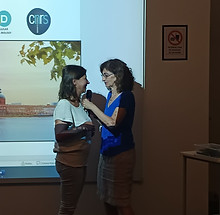
Geneviève Almouzni delivered the "Légion d'honneur" to Gaëlle, at the end of the scientific meeting orgnized for the 10 years of the CBI.
Grand Prix Oberling Haguenau to Gaelle

April 2026
Gaëlle was awarded the "Grand Prix Oberling-Haguenau" of the Fondation ARC.
PEPR-Cell-ID

December 2025
Our lab is involved in the consortium Cell-ID, dedicated to pediatric brain cancer research. Visit the website to learn more, and found out all the opportunities.
Check our new article on scATAC-seq at DSBs

April 2026
Check our new study mainly performed by Sarah and Thomas, recently posted on BioRxiv on resection-coupled chromatin accessibility analyzed in single cells.
"Face Cam"

August 2025
Our local CNRS branch, made a short video in which Gaëlle explains our recent findings and the impact it could generate for medical research.
RECENT ARTICLES

July 2026
In this Review article in Trends in Genetics, we come back on recent mechanistic insights on the transcriptional repression that occur in cis to DSBs, and discuss how these mechanisms could drives the production of distinct RNA species at DSB sites

October 2023
This article Nature shows that a novel chromatin compartment forms in response to DSB induction.

April 2026
In this article posted on BioRxiv, we report how chromatin accessibility is reshuffled at the damaged locus at high resolution. We show that resection-dependent chromatin remodeling events at individual damaged loci display significant heterogeneity in single cells, and can frequently be asymmetric and unidirectional. We also report that coordinated chromatin accessibility patterns at multiple DSBs is ssociated with specific gene expression programs, including DNA damage checkpoint signaling, inflammation and apoptosis.

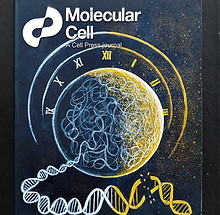
November 2025
This article in Mol Cell shows that, as persistent breaks in yeast, or heterochromatic breaks in drosophila, some DSBs (TC-DSBs, induced in active loci) can reloacte to the nuclear periphery in human cells. At the nuclear enveloppe they are anchored via a protein of the LINC complex, Sun1 but not via Sun2. This process is under the control of PERIOD proteins, that are key factors ensuring circadian oscillations, and we report that consequently, TC-DSB repair is regulated by the cirdadian clock.